Numbers That Tell a Story: How MIS Helps Your Business Grow 

 Your numbers tell a story. Are you using them to guide your next move? 
 
Perhaps you want to expand your business but are unsure where to start. Should you open another location, hire more people, introduce a new service, or strengthen your existing operations first? 
 
Your accounting numbers can help answer these questions, but only when they are organized, accurate, and understood. This is where MIS comes in. 
 
What is MIS? 
 
MIS stands for Management Information System. It brings business information together and turns it into structured reports that help owners understand performance and make informed decisions. 
 
In accounting and finance, MIS reporting connects figures such as sales, expenses, profit, cash flow, and outstanding customer payments. Together, these figures explain where your business stands, what needs attention, and what could support its next stage of growth. 
 
How does MIS help? 
 
A useful MIS goes beyond showing what happened. It helps management understand what the results mean, identify areas requiring attention and make informed business decisions. A well-prepared MIS provides insights in the following areas:
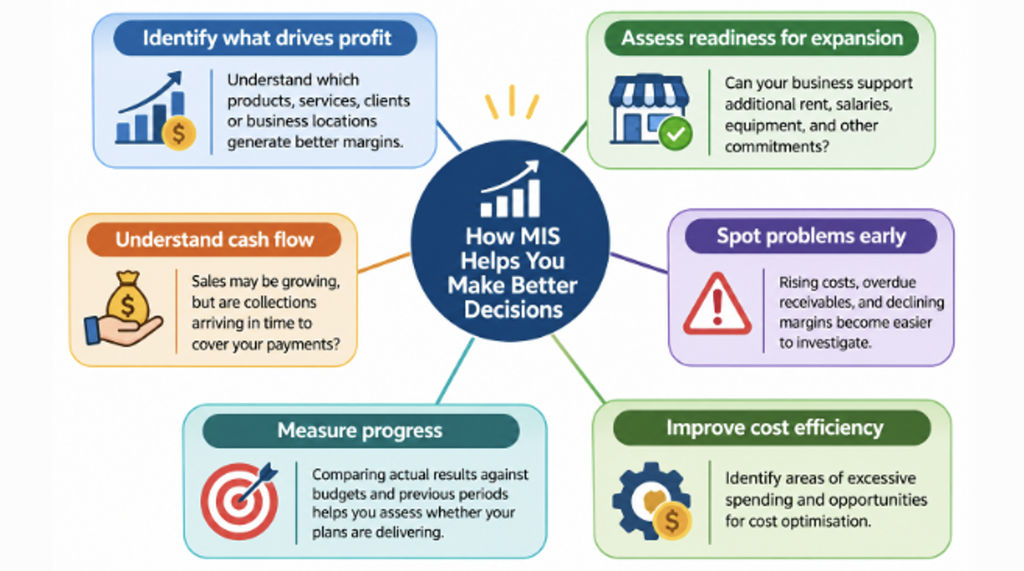

What happens when the numbers are wrong? 
 
Incorrect or incomplete reporting can make a business appear healthier than it is. Owners may expand too quickly, underestimate expenses, or commit funds needed for daily operations. Repeated decisions based on unreliable information can put the business’s survival at risk. 

For example, Strong sales in the management accounts may encourage a business to open a second branch. However, a comprehensive MIS provides a 360-degree view of financial and operational performance, revealing issues such as low margins or slow customer collections. Addressing these areas and strengthening cash flow should come before taking on additional costs, such as expanding the business. 
 
How MMC helps you see the story 
 
At Mohan Management Consultants, we bring structure and clarity to your financial information through well-organised accounting records and consistent MIS reporting. We connect the various aspects of your business operations with their financial impact, bringing together key financial and operational information to provide a complete, 360-degree view of your business performance. 

By managing your accounting and providing meaningful insights into the numbers, we help you make informed decisions and build a stronger foundation for business planning, growth and expansion. 


Your numbers are decision-making tools. MIS helps you put them to work.  

Article Written by: Vidya Ashish

Is Your 2027 Payroll Budget Ready for the New CPF Rates?

Singapore’s CPF contribution rates will change on 1 January 2027. Have you factored the additional costs into your manpower budget?

As businesses prepare their budgets for the new year, one important adjustment deserves attention: higher CPF contribution rates for eligible senior workers.

While the increase may appear small, it can affect employer payroll costs, employees’ take-home pay, and overall manpower planning.

So, what exactly is changing, and how can your business prepare?

What’s Changing in 2027?

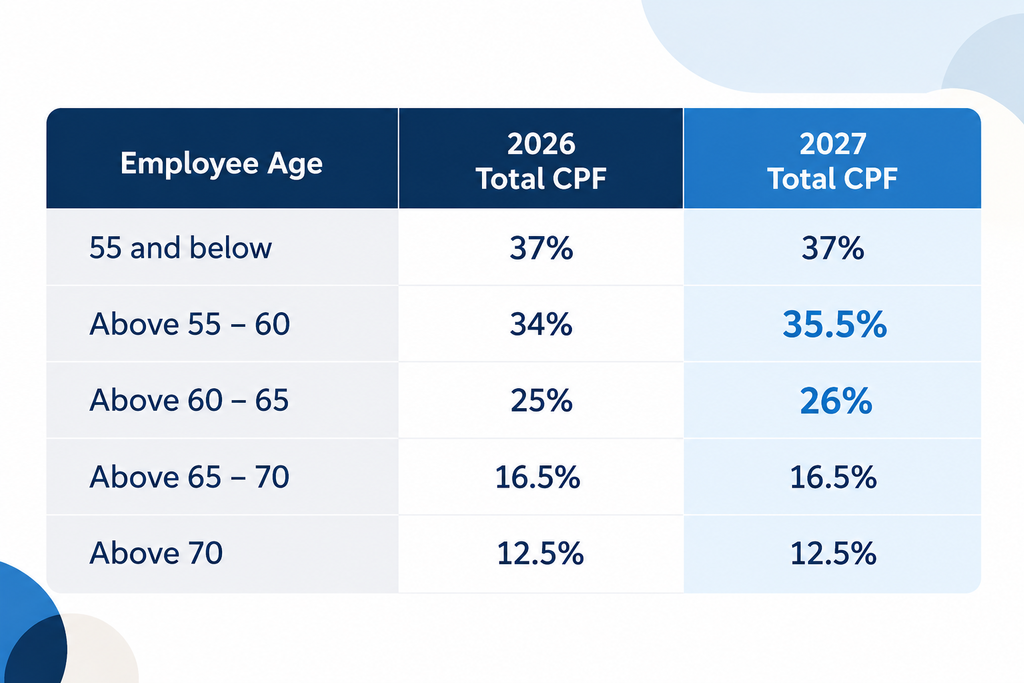
From 1 January 2027, CPF contribution rates will increase for employees aged above 55 to 65, as part of Singapore’s ongoing efforts to strengthen retirement adequacy.

Here’s a quick look at the changes:

Source: CPF Board. Standard rates for Singapore Citizens and third-year-onwards Permanent Residents earning monthly wages above S$750.

A Small Percentage, But What Does It Mean for Your Business?

Consider an eligible employee aged 58 earning S$4,000 monthly.

Under the new rates:

  • S$20 more in monthly employer CPF contributions.
  • S$40 more deducted from the employee’s monthly salary.
  • S$60 more contributed to CPF savings each month.

For a business with several employees in the affected age groups, these adjustments can add up over the year.

The good news? The Government will provide a CPF Transition Offset covering 50% of the increase in employer CPF contributions for eligible employees, helping businesses manage the transition.

Is Your Payroll System Ready?

Beyond adjusting budgets, employers should ensure their payroll processes are prepared for the new rates.

This includes reviewing age-based CPF calculations, updating payroll systems, checking employees approaching the affected age thresholds, and ensuring the correct contribution rates apply to wages earned from January 2027.

Even minor payroll discrepancies can create unnecessary administrative work and compliance risks.

Prepare Today, Stay Compliant Tomorrow

Regulatory changes don’t have to mean additional complexity for your business.

At Mohan Management Consultants (MMC), we help businesses manage payroll, navigate statutory requirements, and stay on top of regulatory developments.

Is your business ready for the 2027 CPF changes?

Connect with MMC to ensure your payroll processes and manpower planning are prepared for the year ahead.

Article Written by: Divya Gomes and Khandalkar Deepti Sunil

Customer Relationship Management: Beyond Software, Building Trust

A new client is always good news for a business. But what makes that client stay?

Is it the quality of service? Competitive pricing? Timely delivery? Or the confidence that someone understands their business and is looking after their interests?

In reality, it is usually a combination of these things.

Customer Relationship Management (CRM) is often associated with software, databases and tracking systems. These tools help businesses organise information and manage follow-ups. But the quality of a relationship depends on how that information is used and how consistently people communicate, coordinate and respond.

For professional service providers, good CRM means understanding each client’s business and providing dependable support as its needs evolve.

1. A Client Relationship Goes Beyond the Completion of Work

Businesses naturally focus on delivering the services they have been engaged to provide. Once an assignment is completed, attention often shifts to the next task or client.

But what happens after the work is done?

A company that initially seeks incorporation services in Singapore may later need accounting, taxation, payroll or corporate secretarial support. As it grows, new responsibilities and decisions arise.

Maintaining a relationship helps a service provider understand those changes and offer relevant guidance at the right time.

The purpose is to remain a useful business partner—someone the client can approach with questions, concerns and changing requirements.

2. Small Actions Shape the Client’s Experience

A timely update. A reminder about an approaching deadline. An acknowledgement of a message. A clear explanation of what happens next.

These actions may seem routine, but they help clients feel informed and supported.

Clients do not necessarily expect every matter to be resolved immediately. They do, however, need to know who is handling it, whether anything is required from them and when they can expect an update.

Responsiveness addresses the immediate concern. Proactive communication helps clients prepare before a concern becomes an urgent issue.

3. A Client Should Experience One Organisation, Not Several Departments

In professional services, a single client may work with corporate secretarial, accounting, taxation and payroll teams. Internally, these teams have different responsibilities. From the client’s perspective, however, they are dealing with one organisation.

Consider a newly incorporated company preparing to hire its first employees. Its needs may now extend to payroll setup and accounting support. A coordinated handover allows the relevant teams to understand the company’s requirements, explain the next steps and build on information already provided.

The client should not have to repeatedly explain the same background or work out which department is responsible for each question.

Clear points of contact, accurate records and shared follow-up arrangements help create a consistent experience. They also support continuity when team members or responsibilities change.

4. Technology Supports Relationship: People Sustain Them

CRM systems can record conversations, track outstanding matters and prompt follow-ups. Their value depends on accurate information and consistent use.

A reminder is useful when someone acts on it. A client record is useful when it helps a team member understand the context and respond appropriately.

Businesses therefore need both suitable tools and clear ownership. Someone must take responsibility for the next step, keep the client informed and ensure that agreed actions are completed.

What Does Good CRM Really Achieve?

Good customer relationship management creates continuity, strengthens communication and helps businesses respond to changing client needs.

For clients, this means less uncertainty and a clearer understanding of the support available to them. For service providers, it creates a stronger foundation for lasting relationships.

At Mohan Management Consultants (MMC), we believe that good client relationships are built through consistent service, attention to detail and an understanding of each client’s business requirements.

As businesses evolve, our role is to remain connected, coordinate across our services and provide dependable support through those changes.

Winning a client starts a relationship. Consistent care and follow-through are what make it last.

Financial Reporting in Singapore Is Changing in 2027. Is Your Business Ready?

The Silent Engine Behind Sustainable Business Growth

When most founders and executives hear the words “Corporate Secretarial Services,” their minds immediately jump to administrative routines: taking board meeting minutes, filing annual returns, and managing statutory registers.

It is easy to view these tasks as mere operational overhead or regulatory red tape. However, viewing corporate secretarial services purely as “paperwork” misses the bigger picture entirely.

In today’s volatile regulatory landscape, corporate secretarial work isn’t just about ticking boxes; it is a strategic function that directly impacts risk management, investor confidence, and corporate longevity.

1. Setting a Rock-Solid Foundation

Every sustainable business begins with structural integrity. When incorporating a business, early decisions regarding share capital structures, constitutional provisions, and director roles establish the rules by which your company will operate for years to come.

A skilled Corporate Secretarial team ensures:

  • Compliant Incorporation: Navigating jurisdiction-specific regulations smoothly from Day 1.
  • Flawless Documentation: Setting up statutory registers accurately so future due diligence processes go off without a hitch.
  • Proper Capital Structure: Preventing costly ownership or governance disputes further down the line.

2. Proactive Risk Management & Compliance

Compliance is rarely top of mind for business leaders—until something goes wrong. Late filings, missed statutory deadlines, or non-compliant corporate registers can result in heavy financial penalties, reputational damage, or even personal liability for directors.

Rather than acting reactively when penalties arise, a robust corporate secretarial strategy acts as a protective shield:

  • Monitoring Statutory Deadlines: Keeping ahead of regulatory changes, board meeting schedules, and filing windows.
  • Mitigating Governance Risks: Ensuring board decisions comply with both corporate laws and company constitutions.
  • Maintaining Investor Trust: Clean records and timely filings signal stability to banks, auditors, and investors.

3. Facilitating Agility During Strategic Shifts

As businesses grow, their corporate architecture inevitably evolves. Whether you are issuing new shares, bringing on fresh investors, onboarding new directors, or expanding internationally, corporate actions require precision.

A dedicated secretarial team acts as an execution engine behind the scenes, drafting resolutions, managing shareholder approvals, and ensuring that strategic decisions translate smoothly into legal compliance without delaying business operations.

The infographic below captures the journey of a Company Secretary through emojis, while the article below explores why these responsibilities matter for sustainable business growth. 👇

Written by: Sonu Lohia – Lead, Corporate Secretarial Department