
Numbers That Tell a Story: How MIS Helps Your Business Grow 

 Your numbers tell a story. Are you using them to guide your next move? 
 
Perhaps you want to expand your business but are unsure where to start. Should you open another location, hire more people, introduce a new service, or strengthen your existing operations first? 
 
Your accounting numbers can help answer these questions, but only when they are organized, accurate, and understood. This is where MIS comes in. 
 
What is MIS? 
 
MIS stands for Management Information System. It brings business information together and turns it into structured reports that help owners understand performance and make informed decisions. 
 
In accounting and finance, MIS reporting connects figures such as sales, expenses, profit, cash flow, and outstanding customer payments. Together, these figures explain where your business stands, what needs attention, and what could support its next stage of growth. 
 
How does MIS help? 
 
A useful MIS goes beyond showing what happened. It helps management understand what the results mean, identify areas requiring attention and make informed business decisions. A well-prepared MIS provides insights in the following areas:
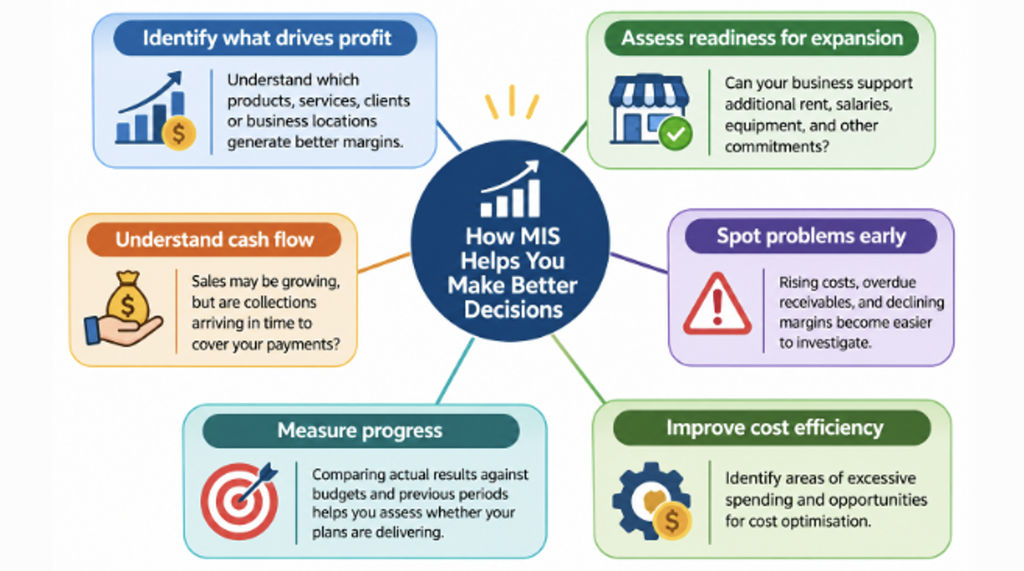

What happens when the numbers are wrong? 
 
Incorrect or incomplete reporting can make a business appear healthier than it is. Owners may expand too quickly, underestimate expenses, or commit funds needed for daily operations. Repeated decisions based on unreliable information can put the business’s survival at risk. 

For example, Strong sales in the management accounts may encourage a business to open a second branch. However, a comprehensive MIS provides a 360-degree view of financial and operational performance, revealing issues such as low margins or slow customer collections. Addressing these areas and strengthening cash flow should come before taking on additional costs, such as expanding the business. 
 
How MMC helps you see the story 
 
At Mohan Management Consultants, we bring structure and clarity to your financial information through well-organised accounting records and consistent MIS reporting. We connect the various aspects of your business operations with their financial impact, bringing together key financial and operational information to provide a complete, 360-degree view of your business performance. 

By managing your accounting and providing meaningful insights into the numbers, we help you make informed decisions and build a stronger foundation for business planning, growth and expansion. 


Your numbers are decision-making tools. MIS helps you put them to work.  

Article Written by: Vidya Ashish

The Business Ecosystem Behind Singapore’s Success

Behind Every Successful Business in Singapore Is an Ecosystem That Most People Never See

When people think about Singapore’s thriving business landscape, they often picture its iconic skyline, world-class infrastructure, and reputation as one of the easiest places in the world to do business.

But the skyline tells only part of the story.

Behind every successful business is an ecosystem of professionals, regulators, financial institutions, and advisers working together to ensure companies are built on a strong foundation and continue to grow sustainably.

Behind Every Successful Business in Singapore Is an Ecosystem That Most People Never See

Imagine Singapore as a city – The buildings may be the most visible part, but they cannot function without planners, roads, utilities, regulations, and the people who keep everything running.

Businesses work in the exact same way.

Every company is part of a larger ecosystem where each stakeholder plays a critical role in supporting business success.

1. Businesses — The Buildings

Businesses form the skyline of Singapore’s economy. They innovate, create jobs, and drive economic growth.

2. Corporate Service Providers — The Master Planners

Much like city planners coordinating the development of an entire district, Corporate Service Providers (CSPs) help businesses navigate incorporation, corporate governance, compliance, accounting, payroll, company secretarial services, and ongoing advisory. Rather than focusing on a single service, CSPs bring together the different elements required to keep a business operating efficiently and compliantly.

3. ACRA — City Hall

Every city needs an authority that maintains order. In Singapore, ACRA oversees business registration and corporate records, helping ensure transparency and accountability within the corporate landscape.

4. Company Secretaries — Building Administrators

Once a company is established, maintaining compliance becomes an ongoing responsibility. Company Secretaries help ensure statutory obligations are met, corporate records remain accurate, and governance requirements are fulfilled throughout the company’s lifecycle.

5. Directors — Building Management

Directors provide strategic direction, oversee operations, and make decisions that shape the future of the business.

6. Shareholders — Building Owners

Shareholders provide the capital and long-term confidence that enable businesses to invest and grow.

7. Accountants — Financial Architects

Financial information forms the foundation of every sound business decision. Accountants help businesses build accurate financial records, monitor performance, and plan for sustainable growth.

8. Auditors — Building Safety Inspectors

Independent reviews strengthen confidence. Auditors assess financial statements and internal controls, providing assurance that businesses meet the required reporting standards.

9. IRAS — City Treasury

Every successful city requires resources to operate. IRAS administers Singapore’s tax system, ensuring businesses contribute fairly while supporting national development.

10. Banks — Power Stations

Businesses rely on access to financial services, funding, and banking infrastructure to operate and expand.

11. Lawyers — Legal Advisers

Legal professionals help businesses navigate contracts, regulations, intellectual property, and corporate transactions while managing legal risks.

12. Corporate Governance & Compliance — The Traffic Rules

Traffic rules may seem restrictive until they’re absent. Similarly, corporate governance and compliance create consistency, accountability, and trust, enabling businesses to operate responsibly while protecting stakeholders.

Why This Ecosystem Matters

One common misconception among entrepreneurs is that incorporating a company marks the end of the setup process.

In reality, it marks the beginning.

Building a successful business requires much more than registration. It requires ongoing compliance, sound governance, financial discipline, strategic decision-making, and access to trusted professional advice.

When these elements work together, businesses can reduce risk, strengthen credibility, and focus on what truly matters are innovation, serving customers, and sustainable growth.

The Bigger Picture

Singapore’s reputation as a global business hub wasn’t built by regulators alone, nor by businesses alone. It was built through collaboration. Regulators create trust. Professionals provide expertise. Financial institutions enable growth. Corporate Service Providers connect the pieces together. Just as no great city is built by a single architect, no successful business thrives in isolation.

It takes an entire ecosystem working together to help businesses start right, stay compliant, and grow with confidence.

Singapore's Business Ecosystem

A visual representation of how businesses, regulators, advisers, financial institutions, and Corporate Service Providers work together to support sustainable business growth.

Article written by: Sonu Lohia

The Silent Engine Behind Sustainable Business Growth

When most founders and executives hear the words “Corporate Secretarial Services,” their minds immediately jump to administrative routines: taking board meeting minutes, filing annual returns, and managing statutory registers.

It is easy to view these tasks as mere operational overhead or regulatory red tape. However, viewing corporate secretarial services purely as “paperwork” misses the bigger picture entirely.

In today’s volatile regulatory landscape, corporate secretarial work isn’t just about ticking boxes; it is a strategic function that directly impacts risk management, investor confidence, and corporate longevity.

1. Setting a Rock-Solid Foundation

Every sustainable business begins with structural integrity. When incorporating a business, early decisions regarding share capital structures, constitutional provisions, and director roles establish the rules by which your company will operate for years to come.

A skilled Corporate Secretarial team ensures:

  • Compliant Incorporation: Navigating jurisdiction-specific regulations smoothly from Day 1.
  • Flawless Documentation: Setting up statutory registers accurately so future due diligence processes go off without a hitch.
  • Proper Capital Structure: Preventing costly ownership or governance disputes further down the line.

2. Proactive Risk Management & Compliance

Compliance is rarely top of mind for business leaders—until something goes wrong. Late filings, missed statutory deadlines, or non-compliant corporate registers can result in heavy financial penalties, reputational damage, or even personal liability for directors.

Rather than acting reactively when penalties arise, a robust corporate secretarial strategy acts as a protective shield:

  • Monitoring Statutory Deadlines: Keeping ahead of regulatory changes, board meeting schedules, and filing windows.
  • Mitigating Governance Risks: Ensuring board decisions comply with both corporate laws and company constitutions.
  • Maintaining Investor Trust: Clean records and timely filings signal stability to banks, auditors, and investors.

3. Facilitating Agility During Strategic Shifts

As businesses grow, their corporate architecture inevitably evolves. Whether you are issuing new shares, bringing on fresh investors, onboarding new directors, or expanding internationally, corporate actions require precision.

A dedicated secretarial team acts as an execution engine behind the scenes, drafting resolutions, managing shareholder approvals, and ensuring that strategic decisions translate smoothly into legal compliance without delaying business operations.

The infographic below captures the journey of a Company Secretary through emojis, while the article below explores why these responsibilities matter for sustainable business growth. 👇

Written by: Sonu Lohia – Lead, Corporate Secretarial Department